
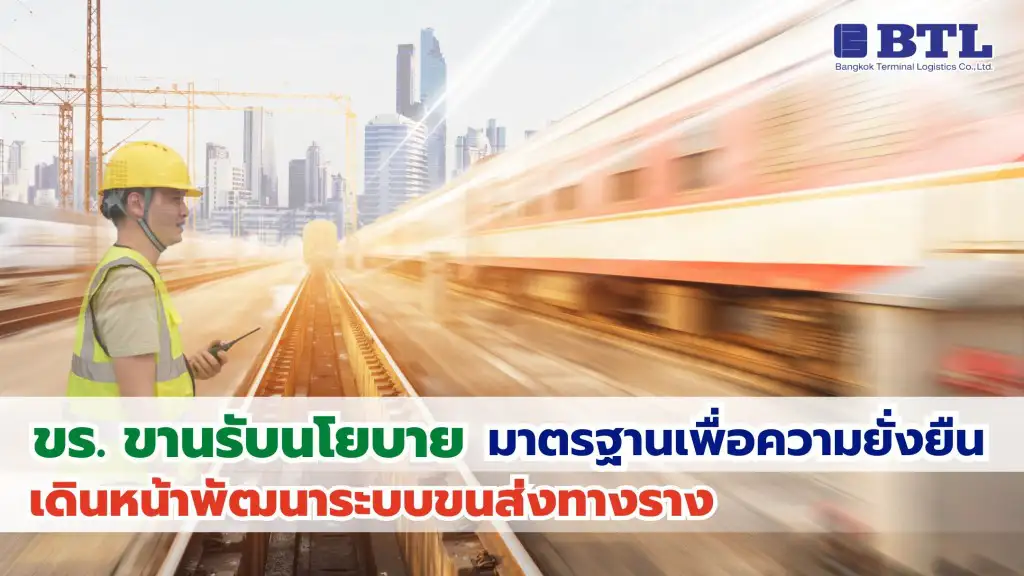
Mr. Somchai Sumanatsakhonkun, Inspector General of the Ministry of Transport, visited and gave a policy for the development of the rail transport system.
Mr. Surapong Piyachote, Deputy Minister of Transport, along with Ms. Naphatra Kamolraksa, Assistant Secretary to the Minister of Transport, and Mr. Somchai Sumanatkhajornkul, Inspector General of the Ministry of Transport, visited and provided operational policies to the Department of Rail Transport.
On October 19, 2023, Dr. Pichet Kunathamrak, Director-General of the Department of Rail Transport, Mr. Athiphu Chitranukroh, Deputy Director-General, civil servants and officials of the Department of Rail Transport welcomed them at the Manangkasila Meeting Room, 2nd floor, Na Thalang Building, K.R.
Mr. Surapong said that according to the transport policy framework “Transportation for the well-being of the people” which aims to create happiness for the people in every dimension, including the economic dimension, the safety dimension, the dimension of providing services that meet international standards, and the dimension of environmental conservation.
The rail transport system is one of the important modes of transportation that can meet all the dimensions mentioned above. Therefore, in order for operations to achieve the set goals, a clear operational policy framework must be established.
To ensure that the operations of the Department of Rail Transport as the main agency in supervising the country’s rail transport system are consistent with government policy and the Ministry of Transport’s policy in driving rail transport missions as follows:
1. Economic: Focuses on regulating and monitoring the development of rail networks both in cities and between cities, the development of intercity rail systems, and the development of dual tracks to connect rail systems both domestically and internationally, with the goal of distributing prosperity both in urban and regional areas and promoting tourism, stimulating the country’s economic system.
2. Safety: By giving importance to the supervision and monitoring of rail system services by upgrading the facilitation and safety services to international standards in both dimensions of increasing efficiency in social services and commercial services.
The objectives are to reduce risks and losses from rail transport, build confidence among the people using the service, prevent and reduce accidents between road and railway intersections by reducing unnecessary intersections, closing illegal crossings, and promoting the construction of crossings or tunnels over the railway to reduce accidents and reduce travel time, including campaigning to make the public aware of safety.
In addition, modern technology innovations are being used to supervise the system to meet standards and safety to meet the needs of people in the digital age, such as the development of the “DRT Crossing” application that collects a database of road and railway intersections for people to access and view various information, and can report accidents or damaged intersections in the application, which will help relevant agencies to be aware and quickly coordinate solutions to prevent accidents.
3. In terms of providing services that meet international standards, we continue to upgrade our services to facilitate and connect people who want to access rail transport, as well as respond to service usage, allowing them to travel from the origin to the destination quickly, conveniently, cleanly, safely, on time, and at a reasonable price, supporting people from all groups, areas, and sectors. – Promote guidelines for setting maximum fares, entry fees, and criteria for increasing rail mass transit fares so that people can access rail transport equally and fairly. Most recently, the government announced a policy of 20 baht for electric train fares for the entire line, or a reduction from the current fare of 14 baht to a maximum of 42 baht, leaving a maximum fare of no more than 20 baht for each line, starting from October 16. Two pilot projects will be implemented:
1. The Metropolitan Rapid Transit (MRT) Project, Chalong Ratchadamri Line (Purple Line), Tao Poon-Khlong Bang Phai Section and
2. The Red Line suburban electric train project, Bang Sue-Rangsit section (Thani Ratthaya Line) and Bang Sue-Taling Chan section (Nakhon Withi Line), with a maximum fare of 20 baht for the entire line, will help reduce travel expenses and encourage people to use the rail system to improve their quality of life.
4. Environmental conservation: Finding ways to reduce greenhouse gases to assess the amount of greenhouse gases reduced from Shift Mode and trading them as carbon credits to provide income back to service providers for further investment in infrastructure.
Including supervision and inspection of operating units in the construction area, with the aim of reducing carbon dioxide emissions and PM 2.5 to reduce global warming.
Mr. Pichet Kunathammarak, Director-General of the Department of Rail Transport, added about the benefits that will be received when the draft Railway Transport Act B.E. … comes into effect, in several aspects, including:
These actions are part of the operational plans of the Department of Rail Transport, which is committed to promoting the development of efficient rail transport. Ready to move forward with the development of rail transport and drive operations in accordance with the policies of the government and the Ministry of Transport.
To make rail transport the country’s main transportation system that is modern, safe, and efficient, and to make people’s quality of life and travel convenient, fast, safe, and enjoyable to use, to become “Transportation for the Well-Being of the People”
Source of information: Department of Rail Transport
————————–
Contact us for BTL service inquiries
02-681-2005 to 9


