Bangkok Terminal Logistics Co., Ltd.



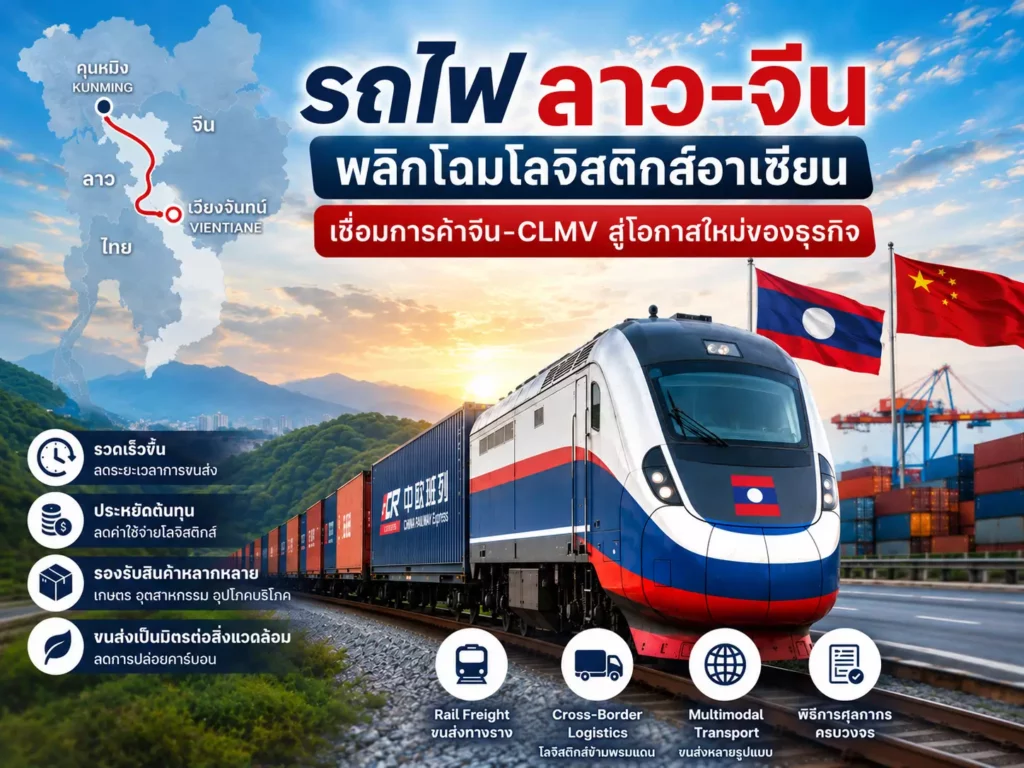
The Laos-China railway is transforming ASEAN logistics, connecting China and CLMV trade to create new business opportunities.
International transportation connectivity is becoming a key driver of the Southeast Asian economy, and one of the most sought-after infrastructure projects is the Laos–China Railway, which is transforming the way goods are transported between China and ASEAN, making it faster, more efficient, and more cost-effective.
Today, this railway line is not just a project connecting two countries, but also a crucial part of a regional logistics network that supports trade between China, the CLMV countries, and ASEAN as a whole.
A new gateway for trade between China and ASEAN.
The Laos-China railway spans over 1,000 kilometers, connecting Kunming, Yunnan Province in China, with Vientiane, the capital of Laos.
This route helps reduce shipping times, which previously took several days for road or sea transport, allowing for faster travel while minimizing uncertainty from weather conditions and limitations of traditional transport methods.
The development of this network also enables Laos to play a significant role as a land-linked country, connecting China with Southeast Asia.
Cross-border trade continues to grow.
Since its opening, the Laos-China railway has seen a continuous increase in freight volume, accommodating a wide variety of goods including agricultural products, food, fruits, machinery, industrial raw materials, and consumer goods.
Products that benefit from the rail system include:
- Fresh fruits such as durian, mangosteen, and longan.
- Rubber
- Cassava
- rice
- electrical appliance
- industrial machinery
- Electronic products
Using rail systems helps maintain product quality, especially temperature-controlled goods, and enables more timely delivery.
Reduce costs and improve logistics efficiency.
Compared to road or sea transport, rail transport has several advantages, including:
- Reduce shipping time.
- Increase punctuality.
- Capable of handling large volumes of goods.
- Reduce unit costs.
- Reduce the risk of port congestion.
- Support environmentally friendly transportation.
As a result, many businesses have begun to adapt their logistics plans to adopt multimodal transport, which integrates road, rail, and sea transport, in order to increase the efficiency of their supply chains.
Opportunities for Thai exporters.
For Thailand, the Laos-China railway is considered another important channel for expanding into the Chinese market.
Businesses can utilize the railway system in conjunction with the domestic transportation network to quickly ship goods to Kunming and distribute them to other major economic cities in China.
Potential Thai export products include:
- fresh fruit
- Processed foods
- agricultural products
- Industrial raw materials
- chemical
- Industrial parts
- Consumer goods
- BTL is ready to connect your business to China and the CLMV region.
The Laos-China railway is not just transportation infrastructure; it is becoming a key driver of the region’s economy and trade. Connecting the rail system with Thailand’s logistics network will open new opportunities for businesses to easily access the Chinese market and enhance their competitiveness in the international trade arena.
By choosing the right transportation solutions, businesses can manage costs efficiently and gain a competitive advantage in the interconnected supply chain across the ASEAN region.