Bangkok Terminal Logistics Co., Ltd.



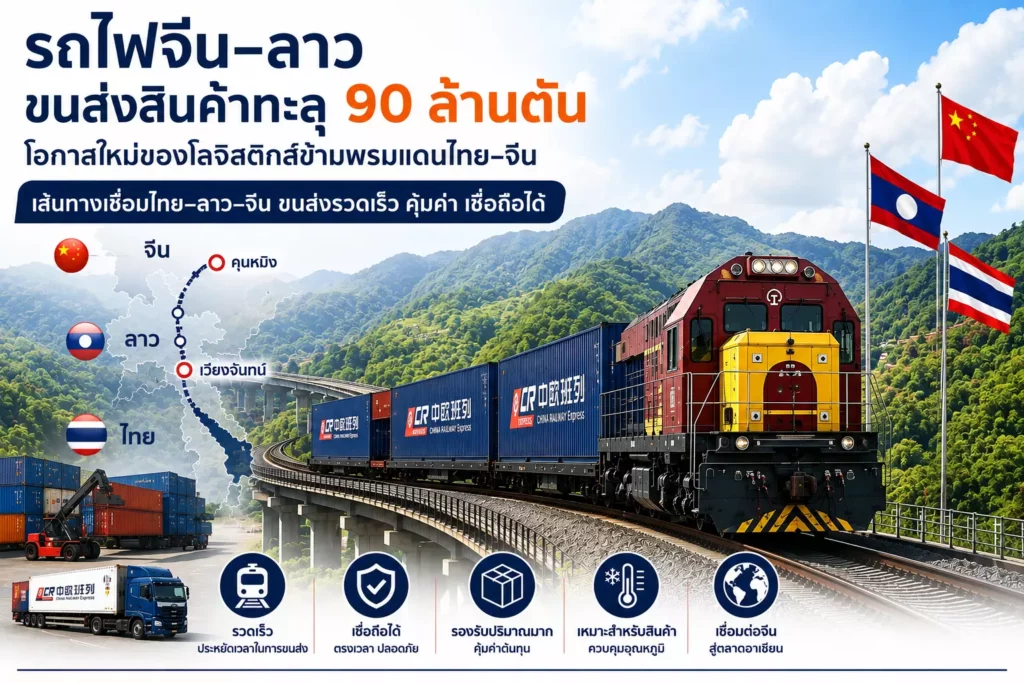
The China–Laos Railway surpasses 90 tons of transport capacity, presenting new opportunities for cross-border logistics between Thailand and China.
Over the years, the China-Laos railway has transformed from a vital transportation infrastructure to one of the main arteries for trade between China and ASEAN. Recently, the cumulative cargo volume along this route surpassed 90 million tons, while cross-border trade value continues to grow. This reflects the fact that rail transport is becoming a key choice for businesses seeking speed, cost-effectiveness, and reliability.
For Thailand, the growth of the China–Laos Railway is not just news of an infrastructure achievement, but also a significant opportunity to enhance trade between Thailand and China through an efficiently connected cross-border logistics system.
Why is this route important to Thai trade ?
Currently, the China–Laos Railway connects transportation networks from southern China, through Laos, to Thailand, and can be continuously extended to other countries in Southeast Asia.
Compared to road transport alone, multimodal transport (rail + road) offers several advantages, including:
- Reduce transportation time between China and the ASEAN region.
- Improve the consistency of train schedules.
- Efficiently handles the transportation of large volumes of goods.
- It helps reduce long-term logistics costs for exporters and importers.
This railway network also connects to important economic cities in China, such as Kunming, Chengdu, and industrial cities in Yunnan Province, which are key markets for Thai businesses.
Which types of Thai products have benefited the most ?
One of the product groups showing outstanding growth is agricultural products and fresh food, especially fruits that require temperature control, such as durian, mangosteen, and longan, as well as chilled food products and processed agricultural products.
In addition, this route is also suitable for industrial goods that require punctuality, such as:
- electronic components
- Machinery and equipment
- Consumer goods
- Medical supplies and temperature-controlled goods.
Having a variety of transportation options allows businesses to choose the route that best suits their cost, time, and product characteristics.
Multimodal logistics is key to competitiveness.
Although trains are the heart of this route, the success of transportation is not due to the “rails” alone.
What exporters need is a system that can connect trucks, trains, warehouses, and customs clearance to work as a single process, from origin to destination.
This concept is called Multimodal Logistics, which is becoming increasingly popular because it provides greater flexibility in transportation and reduces the risk of relying on a single mode of transport.
Opportunities for Thai businesses in the Chinese market.
The growth of the China–Laos Railway provides Thai businesses, especially SMEs, with easier access to the Chinese market in terms of both cost and transportation time.
If logistics routes are planned properly, businesses can…
- Faster delivery of goods.
- Increase price competitiveness.
- Expanding into growing secondary cities in China.
- Catering to the needs of customers who prioritize punctuality.
The role of BTL in connecting Thailand–Laos–China.
BTL provides cross-border logistics services covering Thailand, Laos, China, and neighboring countries. Our solutions connect road, rail, and multimodal transportation, offering customs clearance, warehousing, and temperature-controlled cargo services.
In an era where infrastructure is opening up new opportunities for international trade, choosing a logistics partner who understands routes, regulations, and supply chain management is a key factor in ensuring stable business growth in regional markets.