Bangkok Terminal Logistics Co., Ltd.



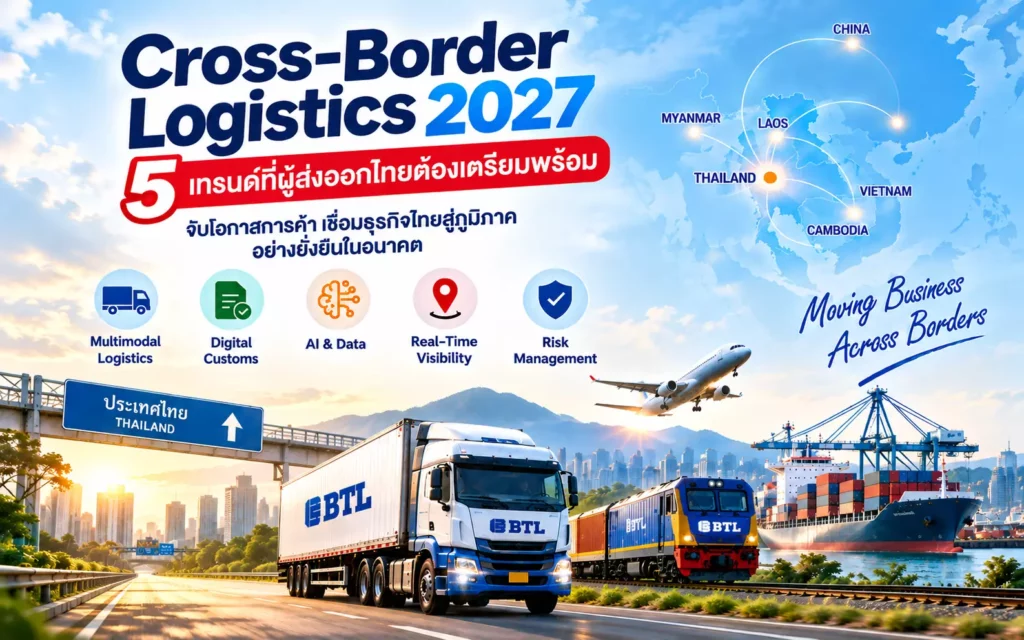
Cross-Border Logistics 2027: 5 Trends Thai Exporters Must Prepare For.
International trade is rapidly changing due to technology, regulations, and economic fluctuations. Therefore, cross-border logistics encompasses not just the transportation of goods across countries, but also the efficient management of routes, information, costs, time, and risk.
Especially along the Thailand-Laos-China route, with more road and rail transport options available, businesses can better plan routes to suit their goods, costs, and transportation times. As we enter 2027, here are 5 key trends that exporters and importers should prepare for.
1. Multimodal Logistics: Connecting multiple modes of transportation.
The integration of road, rail, sea, and air transportation will play an increasingly important role in balancing speed, cost, and volume of goods.
For the Thailand–Laos–China route, road and rail connectivity enhances transportation options, linking Thailand, through Laos, to China, and further expanding into international transportation networks. Businesses should therefore seek the “most suitable” route rather than simply the “fastest” one.
2. Digital Customs: Customs procedures go digital.
Electronic document systems and data linkages have made import-export processes more efficient, but data accuracy remains crucial.
Especially for cross-country shipments, such as those between Thailand, Laos, and China, businesses should thoroughly check the invoice, packing list, HS code, licenses, and requirements of the origin, transit countries, and destination countries to minimize the risk of delays in customs clearance.
3. AI & Data: From problem solving to forecasting.
AI and data analytics will increasingly assist in logistics management, from route planning and delivery time forecasting to risk assessment.
For cross-border logistics with multiple connection points, the effective use of data helps businesses shift from “solving problems as they occur” to “anticipating and preventing problems in advance.”
4. Real-Time Visibility: Know the status of your shipment at all times.
Modern customers want more than just delivery dates; they want to know where their product is and what stage of the process it’s in.
Especially for cross-border routes between Thailand, Laos, and China, which may involve border crossings and connections between road and rail, tracking shipment status will help businesses plan their warehousing, production, and delivery more accurately.
5. Risk Management: Have a backup plan in place before problems occur.
Regulations, weather conditions, border congestion, or route restrictions can all affect transit times.
Having options for road, rail, and multimodal transport, along with preparing alternative routes and contingency plans, will help businesses adapt and mitigate the impact on the supply chain when unforeseen events occur.
Get ready today for more efficient cross-border logistics.
All five trends reflect that cross-border logistics in 2027 is not just about moving goods “from point A to point B,” but about managing routes, documentation, information, time, costs, and risks simultaneously.
Bangkok Terminal Logistics (BTL) is ready to support cross-border transportation, connecting Thailand, Laos, and China, as well as the CLMV region and Southern China, with transportation options including road, rail, and multimodal logistics. We offer customs clearance, warehousing, and distribution services to help businesses manage their supply chains more efficiently and flexibly.